Showing posts with label Theory. Show all posts

Friday, 31 August 2012

"VIENNOISERIES" (VIENNESE BREADS)

Viennoiseries include all laminated doughs, yeasted-laminated doughs and rich yeast doughs. They are normally richer than normal breads. 

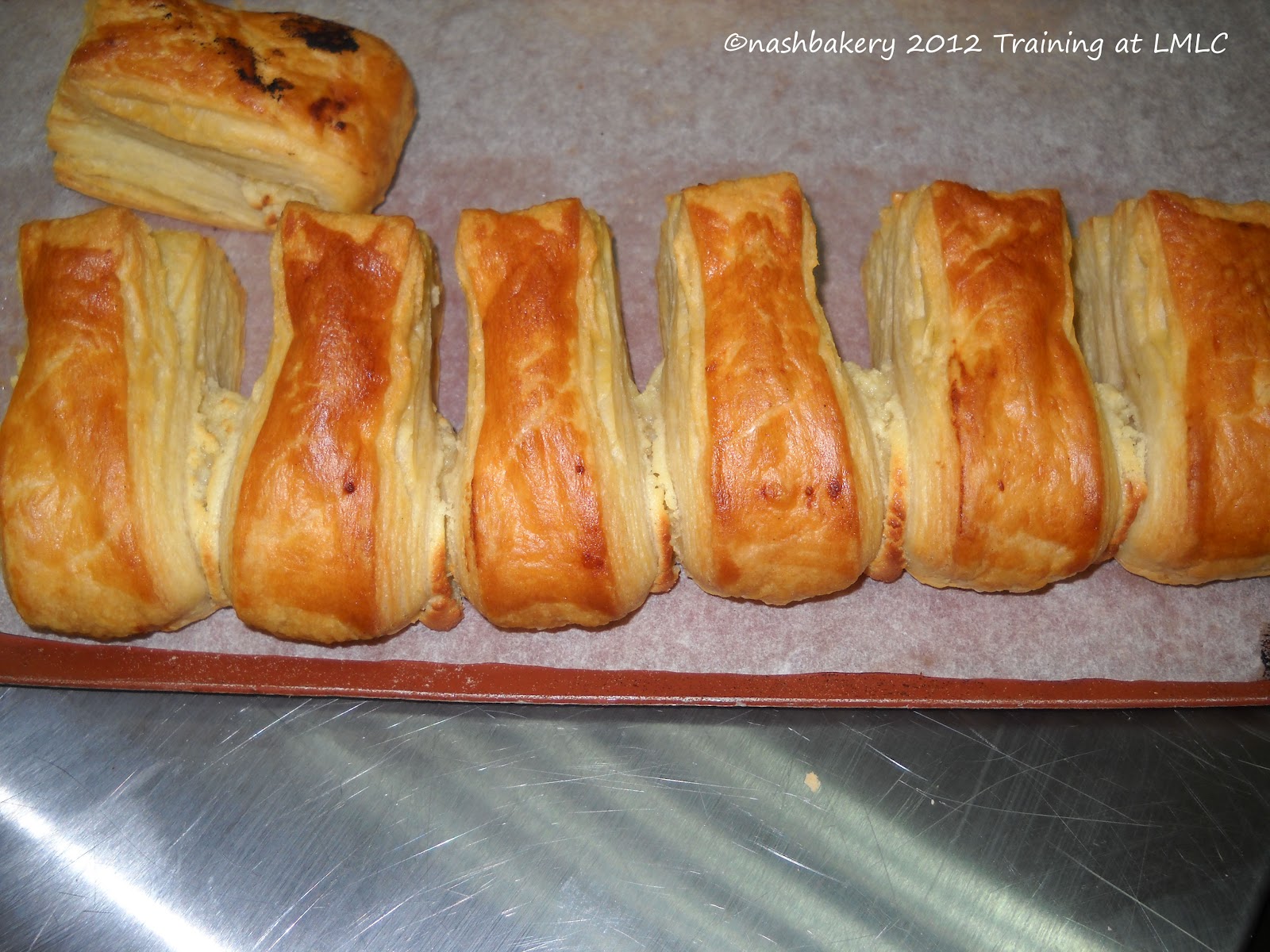
Here are some pictures I took during the training on "Viennoiserie for Professionals" at La Fournée des Moulins.  Endless thanks to Mr Laval who shared his knowledge with us.

"Brioche Mauricienne" (Mauritian Brioche)

Mauritian brioche dough: with a cross; topped with flavoured butter and sugar; double knot  

Have a look at the back of the Mauritian brioche

"Brioche Feuilletée" -  Laminated Brioche (This was done using the Mauritian brioche dough)

"Pain au Lait Bicolore" (Two-coloured Milk Bread)

Making of "Pain au Chocolat"

Shaping the Danishes

Danishes with Frangipane and Peach

"Brioche Épis avec Crème de Pistache" (French brioche dough shaped like a wheat stalk stuffed with pistachio cream)

Making of "Pain au Raisins".  He used pastry cream and chocolate chips instead of raisins.

"Brioche Royale" (Made using French brioche dough; the dough is shaped into a ball, topped with a macaroon batter and then dusted with icing sugar thrice before baking)

Flaky Pastry with Pastry Cream

I don't remember the name of this but it's a French brioche stuffed with French spice cake (pain d'épice)

Basically what we learnt :-)


Sunday, 8 July 2012

WINDOWPANE TEST

"Breadmaking works miracles on all levels. The slow, rhythmic kneading is therapeutic, opening up the lungs and rib cage and releasing stresses and strains with gentle efficacy. Watch as the warmth and pressure of your hands bring the yeast to life and transform a few commonplace ingredients into a growing dough."
TREUILLE, E. & FERRIGNO, U. (2004)

Flour contains two major proteins, namely, gliadin and glutenin.  These two proteins are able to link to each other when hydrated. When they link up, they create a more complex protein called gluten.  Gluten is very important since it provides flavour and texture.  Gluten can be developped by kneading.

The most reliable method to determine when gluten development is sufficient is called the windowpane test, sometimes referred to as the membrane test. This is performed by cutting off a small piece of dough from the larger batch and gently stretching, pulling, and turning it to see if it will hold a paper-thin, translucent membrane.  If the dough falls apart before it makes this windowpane, continue mixing for another minute or two and test again (Reinhart, 2001).

Can you see my finger through it??
REFERENCES

REINHART, P. (2001), The bread baker’s apprentice : mastering the art of extraordinary bread, Ten Speed Press (Imprint of Crown Publishing Group), United States.

TREUILLE, E. & FERRIGNO, U. (2004), Ultimate Bread, 2nd edn, DK Publishing Inc., United States.


Saturday, 21 April 2012

AERATION TEST

Creamed cakes are basically cakes whose fat and sugar are creamed together until light and fluffy during the preparation of the batter.  According to Corriher (2008) - Author of BakeWise - the creaming procedure is vital for the final volume of the cake.  This is because during creaming tiny bubbles of air are incorporated in the fat-sugar mixture (Davies, 1999).  

How would you know when to stop the creaming method? 

We can determine whether creaming has completed by looking at the colour and texture of the creamed mixture. Creaming is complete when the creamed mixture is pale, light and fluffy.  

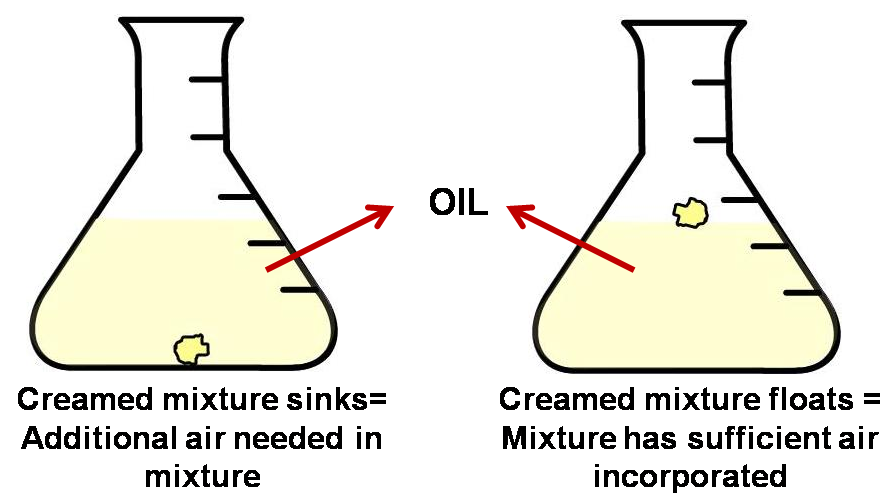
Another way to test doneness of the creaming method is by using the aeration test. This can be done by dropping a fine speck of creamed mixture from a fine skewer on to the surface of a beaker of oil  If the mixture floats, it has been creamed enough (Davies, 1999).  

___________________________________________________________________________________________
Figure 1 - Aeration Test


REFERENCES

Corriher, O.S. (2008), BakeWise: The Hows and Whys of Successful Baking, p. 121, Scribner, New York. (Accessed on 21/04/12). <http://books.google.mu/books?id=b-iwjIb2RxwC>. 

Davies, J. (1999), Hammond's Cooking Explained, 4th edn, Addison Wesley Longman Limited.

Picture of Conical Flask: <http://www.clker.com/clipart-tubito.html>.

Sunday, 1 April 2012

BAKING EQUIPMENT

1. LARGE EQUIPMENT

Mixers
Mixers are commonly used for mixing cake batters and biscuit doughs, kneading bread doughs, whisking and whipping eggs and cream respectively.

1.1 - Mixer and mixer attachments

Ovens
An oven is a hot chamber in which food is heated by hot air.  It is indispensable to have a good oven for good baking.

1.2 - Digital oven

Steamers
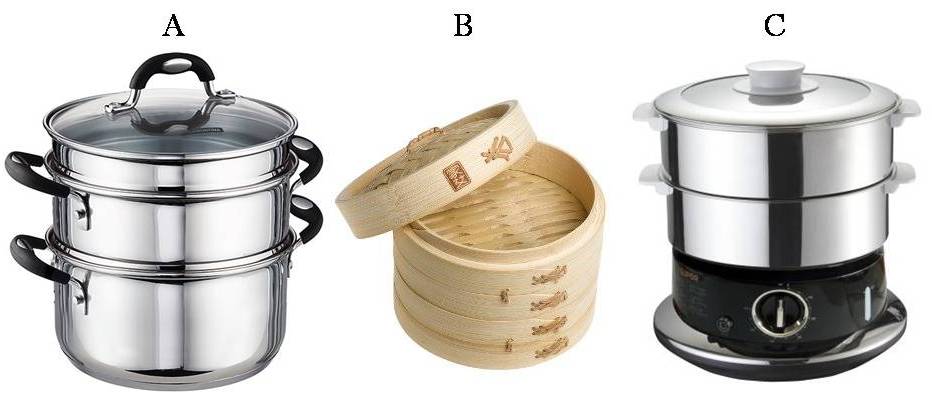
Steamers is not a baking equipment but is important for making steamed buns, steamed puddings and certain Chinese or Japanese sponge cakes.

1.3 - A: Stainless steam stove-top steamer, B: Bamboo steamer (Stove-top steamer), C: Electric steamer


Food Processors
These are useful for grinding nuts and spices and making fruit purées.  Some food processors can be used for mixing biscuit doughs which require minimum handling.

1.4 - A Multi-function food processor
2. PANS, CONTAINERS AND MOULDS

Cake and Pastry pans
Cake and pastry pans can be made of glass, silicone, ceramic, aluminium and non-stick materials.  Some baking pans are even made of paper.

2.1 - Types of bakeware

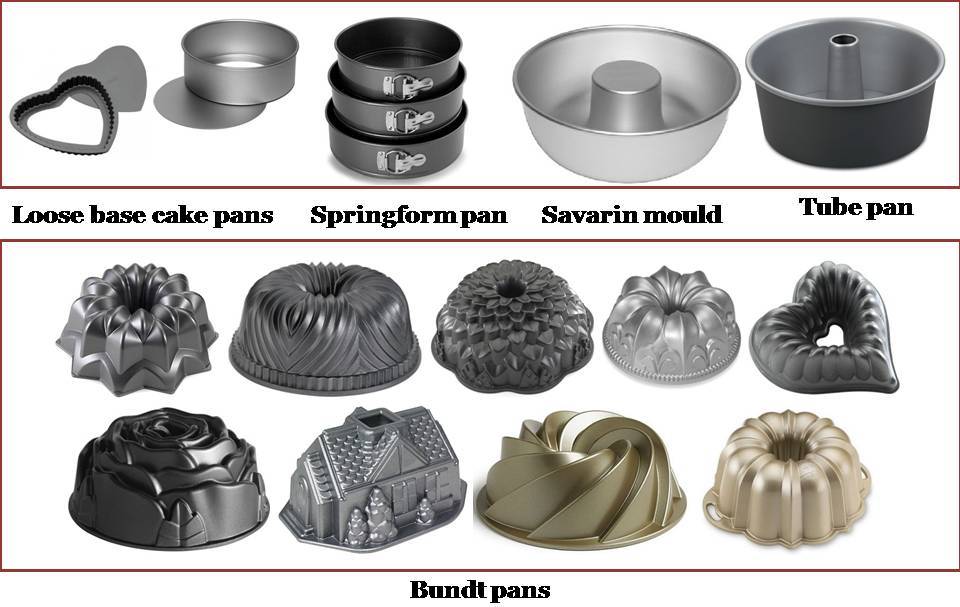
Below are different cake and pastry pans  available for different types of cakes and pastries.

2.2 - Cake and pastry pans

3. BAKING ACCESSORIES
 
3.1 - Important accessories for making and decorating baked goods

4. THERMOMETERS & SACCHAROMETERS

4.1 - Types of thermometers and sugar thermometer


5.  KITCHEN ESSENTIALS

5.1 - Kitchen aprons
5.2 - Oven gloves
5.3 - Kitchen towels
5.4 - Cellulose kitchen sponges


REFERENCES
  • Exploratorium. Science of candy: Cooking Lab. Thermometer picture. <http://www.exploratorium.edu/cooking/candy/kitchenlab.html>. (Date Accessed: 01/04/12)
  • My Favourite food. Apron picture. <http://favouritefood.wordpress.com/about/>. (Date Accessed: 01/04/12). 
None of the pictures on this page are mine.  All of them have been downloaded from the internet and compiled purely for educational purposes.  If ever owners  of these pictures would like me to acknowledge their name, kindly comment below.     

    Sunday, 11 March 2012

    CAKE MAKING TECHNIQUES

    There are many factors which affect the final quality (Texture, Flavour, taste, tenderness, moistness and appearance) of a cake.  Some of them are the quality of the ingredients used, the temperature of the ingredients, the methods used for mixing the cake, time of mixing, altitudes, baking time and temperature, size of cake pan used and type of cake pan and so on.  

    According to Gisslen (2005), there are basically two types of cake, namely, High Fat or Shortened Cakes and Low Fat or Foam Type Cakes.  

    HIGH FAT OR SHORTENED CAKES 
    The main ingredients used to make shortened cakes are: fat, sugar, flour, raising agents (baking powder or  baking soda) and liquid (water, milk, buttermilk, orange juice, etc...).  There are different methods for preparing shortened cakes as summarised below.

    Method
    Preparation techniques
    Comments
    Creaming method/Sugar-batter method/ Conventional method
    • The fat and sugar are creamed together until light and fluffy
    • The eggs are beaten in one by one or in a steady stream
    • The flour sifted with other dry ingredients (Cocoa, baking powder, baking soda or salt) is mixed in batches alternating with the liquid, if used, to form a clear smooth batter without any lumps. Care should be taken not to over-mix
    A light cake with high volume is produced
    Two-stage method (The liquid is added in two stages)
    • The flour, sugar and other dry ingredients (salt, cocoa, baking powder, and baking soda) are sifted in a bowl
    • The fat, mainly shortening, and part of the liquid are mixed into the flour at low speed
    • The remaining liquid is combined with lightly beaten eggs and mixed gradually into the mixture

    OR
    • The fat is mixed into the sifted flour (including salt, baking powder and soda)
    • All other dry ingredients (cocoa and sugar) and part of the liquid are added
    • The remaining liquid is combined with lightly beaten eggs and mixed gradually into the mixture 

    (The second method can also be called the pastry-blend method)
    A moister, velvety and tender-crumbed cake, compared to other methods, is obtained
    Flour-batter method
    • The fat is blended into the sifted flour (including salt, baking powder and soda) until light and smooth
    • The eggs and sugar are whipped together until thick and light
    • The flour-fat mixture and the sugar-egg mixture are combined and mixed until smooth
    • Liquid is finally mixed in little by little until smooth
    A fine-textured cake is produced, but there may be some toughening due to the development of gluten
    All-in-one method/Single-stage method/One-bowl method
    • All the sifted dry ingredients and the other ingredients are placed in mixing bowl and mixed into a homogeneous mixture at low speed for 1-3 minutes, followed by mixing at medium speed for 3-5 minutes, and finally again at low speed for 2 minutes, for a total mixing time of 8-10 minutes
    A coarse cake is produced with limited keeping qualities
    Muffin method (Two-bowl method)
    • The liquid ingredients, eggs and oil or melted fat are combined
    • The dry ingredients including the sugar are sifted together
    • The two mixtures are stirred together until blended sufficiently to develop the necessary gluten
    A coarse cake is produced with limited keeping qualities

    LOW FAT OR FOAM TYPE CAKE
    Egg is the main ingredient in a foam type cake.  The eggs incorporate air into the mixture and contribute to the cake structure.  According to Gisslen (2005), egg-foam cakes have a springy texture and are tougher than shortened cakes.  This makes them valuable for many kinds of desserts that require much handling to assemble.  Very little fat or no fat is added in the cake.  To produce, good quality foam type cake, it is indispensable to use weak flour of fine granulation, preferably soft or cake flour.  The flour can be further weaken by the addition of cornstarch.  Sponge cakes, angel food cakes and chiffon cakes are examples of foam type cakes.

    Sponge Cakes
    Although there are many types of sponge cakes, they all have one characteristic in common: They are made with an egg foam that contains yolks (Gisslen 2005).  The basic ingredients for a sponge cake are Eggs, Sugar and Flour.

    .......Method.......
    .......Procedure.......
    Plain sponge method
    1. The eggs, sugar and salt are combined and then slightly beaten over a hot water bath until the mixture warms to a temperature of about 43°C. (The foam attains greater volume if it is warm).
    2. The beaten egg is taken off from the water bath and then beaten at high speed with a mixer until it is very light and thick.  Flavouring can be whipped in, in a steady stream.
    3. Sifted flour and cornstarch are folded in the foam in 3-4 stages.  Many bakers prefer to do this step by hand even for large batches.
    4. The cake is immediately panned and baked to prevent loss of volume.
    VARIATION 1
    Butter Sponge or Genoise (Genoese)
    Gently fold in the melted butter after the flour has been added.  Care should be taken not to over-mix.  The cake batter is panned and baked immediately.

    VARIATION 2
    Hot Milk and Butter Sponge
    The milk and the butter is heated until the butter is melted.  The hot mixture is poured in 3 stages into the basic sponge cake mixture after flour has been folded.  The cake batter is immediately panned and baked.

    Egg-separated method
    1. The yolks are beaten with half of the sugar until light and fluffy.
    2. The egg whites and the other half of the sugar are whipped until moist peaks are formed.  
    3. The egg whites and the sifted dry ingredients are alternately folded into the yolk.
    4. Melted butter can then be folded in.  The cake batter is immediately panned and baked.

    This is one of the best video I have seen so far on how to make a Genoise using the plain sponge method (Video uploaded by ChefHaymon's):


    Angel Food Cake
    Angel food cake is leavened only by air and steam, with no chemical leavening.  The air and steam are primarily derived from the egg whites, which with sugar constitute the main ingredients of the cake.  Sugar is the tenderizing agent for the cake since the cake does not contain shortening.  Care of the egg whites is important for a successful cake.  The eggs should be separated when cold and allowed to warm to room temperature. There should be no trace of egg yolk (fat) in the white since the presence of fat will hinder the whites from beating. In addition, the bowl, beaters, and tube pan must be also grease free (Conforti, 2006).

    Procedure: Angel Food Method
    1. Have all ingredients at room temperature. The egg whites may be slightly warmed in order to achieve better volume.
    2. Sift the flour with 40-50% of the sugar. This step helps the flour to mix more evenly with the foam.
    3. Whip the egg whites, to which salt and cream of tartar have been added, until they start to form soft peaks.
    4. Gradually add the remaining sugar (50-60%) in a slow stream, whipping continuously until the meringue retains soft moist peaks.
    5.  Fold in the flour-sugar mixture gently.
    6. Pour the mixture in an ungreased tube-style pan and bake immediately.

    Chiffon Cakes
    Chiffon cakes and angel food cakes are both based on egg-white foams.  The differences are that:
    • Chiffon cakes contains fat (Yolk and liquid fat) while angel food cakes are fat-free.
    • In angel food cakes, a dry flour-sugar mixture is folded into the egg whites while in chiffon cakes, a batter containing flour, egg yolks, vegetable oil, and water is folded into the whites.
    • Egg whites for chiffon cakes should be whipped until they are a little firmer than those for angel food cakes,but do not whip them until they are dry.  
    • Chiffon cakes contain baking powder, so they do not depend solely on the egg foam for all their leavening.
    Procedure: Chiffon Method
    1. Sift the flour, baking powder and part of the sugar into a mixing bowl.
    2. Gradually beat in the oil, yolks, liquid and flavourings.  Mix until smooth and care should be taken not to overmix.
    3. Whip the egg whites in a separate bowl until they start to form soft peaks.  Add the cream of tartar and sugar in a stream whipping continuously until stiff but not dry. 
    4. Fold the whipped egg whites into the batter.  Immediately pour in ungreased tube-style pan and bake.

    COMBINATION METHOD 
    This is also called Creaming/Sponge Method whereby two methods are combined together.  The whipped egg whites act as a leavening agent and thus make the cake lighter.
    Procedure 1: 
    1. Cream the butter and half of the sugar until light.  Beat in the egg yolk one by one until the mixture is fluffy.
    2. Whip the egg whites and the remaining sugar to a stiff meringue.  Fold the meringue in the creamed butter mixture.  
    3. Sift in the dry ingredients and fold.  Bake in a greased and lined tin.
    Procedure 2:
    1. Cream the butter and half of the sugar until light.  Beat in the egg yolk one by one until the mixture is fluffy.  Sift in and fold in 1/2-3/4 of the flour.  
    2. Whip the egg whites and the remaining sugar to a stiff meringue.  Fold half of the meringue into the cake mixture, then fold in the remaining sifted flour.
    3. Complete by folding in the remaining whipped egg whites.  Bake in a greased and lined tin.


    REFERENCES
    Conforti, F.D. (2006), 'Cake Manufacture', in Hui, Y.H. (ed.), Corke, H., De Leyn, I., Nip, W. and Cross, N. (Assoc. eds), Bakery Products: Science and Technology, Blackwell Publishing Ltd, UK.

    Davies, J. (1997), Hammond's Cooking Explained, 4th edn, Addison Wesley Longman Limited.

    Gisslen, W. (2005), Professional Baking, 4th edn, John Wiley & Sons, Inc., New Jersey.

    Hanneman, L.J. (2005), Patisserie, 2nd edn, Elsevier Ltd, USA.